
Hostinger vs HostGator compared on pricing, renewals, speed, support, WordPress, and hidden costs. See which host is better for beginners and long-term value.
If you are searching for Hostinger vs HostGator, you are likely trying to find the better host for pricing, ease of use, and long-term value. If you are comparing Hostinger vs HostGator, you are probably close to buying.
Both are well-known names in budget hosting. Both offer shared hosting, WordPress-friendly plans, free SSL, and beginner-focused messaging. But they are not the same kind of value. Hostinger leans into low entry pricing, a custom hPanel dashboard, free migration, and a more guided beginner experience. HostGator leans into cPanel familiarity, traditional shared hosting, and broad support availability.
For most beginners, bloggers, and small business owners, Hostinger is the stronger overall pick. For buyers who specifically want cPanel and a more traditional hosting setup, HostGator can still make sense.
Table of Contents
Quick Verdict
Choose Hostinger if you want the better all-around beginner host with stronger value, easier onboarding, and a cleaner setup experience.
Choose HostGator if you specifically want cPanel and prefer a more traditional shared hosting environment.
Avoid both if your site is revenue-critical, you hate renewal surprises, or you already know you will need more premium performance and support.
Hostinger vs HostGator Comparison Table
This Hostinger vs HostGator comparison table highlights the biggest differences that matter before you buy.
| Category | Hostinger | HostGator | Best For |
|---|---|---|---|
| Best for | Beginners, bloggers, affiliate sites, small businesses | cPanel users, traditional hosting buyers | Depends on workflow |
| Starting point | Lower promo-led pricing | Budget-friendly, but less compelling value overall | Hostinger |
| Control panel | hPanel | cPanel | Depends on preference |
| WordPress fit | Very beginner-friendly | Good, but more traditional | Hostinger |
| Migration | Free unlimited website migration | Migration options available, but some cases can be paid | Hostinger |
| Support | 24/7 support | 24/7/365 support messaging | Slight edge HostGator |
| Free domain | Available on qualifying plans | Available on qualifying plans | Tie |
| Email notes | Plan-specific inclusions | Professional Email trial can auto-renew | Hostinger |
| Refund policy | 30-day money-back guarantee | 30-day money-back guarantee on current help page | Tie |
| Overall value | Stronger for most buyers | Better only for certain users | Hostinger |
Hostinger’s current hosting pages highlight free migration, free SSL, a 30-day guarantee, and 99.9% uptime. HostGator’s shared hosting pages highlight cPanel, free SSL, a free domain on qualifying plans, one-click WordPress installs, and 24/7/365 support.
How We Compared Them
This comparison focuses on what matters most to decision-stage buyers:
- real value, not just intro pricing
- renewal pricing risk
- ease of use for beginners
- WordPress fit
- support and troubleshooting experience
- backups, security, and included extras
- email and domain caveats
- who each host is actually best for
That matters because many ranking comparison pages do a fine job with feature tables, but still stay too generic on long-term value, hidden costs, and who should skip each host.
Hostinger Overview
Hostinger is built for buyers who want a simpler start.
Its biggest selling points are low promotional entry pricing, beginner-friendly onboarding, its custom hPanel dashboard, and free unlimited website migration. Hostinger also makes a stronger value impression in current third-party comparison coverage, especially for first-time site owners and WordPress beginners.
Best for
Hostinger is best for beginners, bloggers, affiliate marketers, portfolio sites, and small business owners who want a low-friction setup.
Main strengths
The biggest strengths are ease of use, value, migration support, and beginner fit. It is usually easier to recommend when the buyer wants the smoothest first hosting experience.
Main weaknesses
The main drawback is that Hostinger uses hPanel, not cPanel. That is not necessarily bad, but buyers who prefer a standard hosting environment may see it as a downside. The other weakness is that promo pricing can make the host look cheaper than it will feel after renewal.
HostGator Overview
HostGator still appeals to buyers who want a more familiar hosting setup.
Its biggest advantages are cPanel, traditional shared hosting structure, free SSL, free domain offers on qualifying plans, and strong support availability messaging. For buyers who have used hosting before or simply prefer a classic hosting dashboard, that can still be a real advantage.
Best for
HostGator is best for users who want cPanel, standard hosting workflows, and a more traditional shared hosting feel.
Main strengths
The biggest strengths are cPanel familiarity and support positioning. HostGator still makes sense for buyers who value convention over a newer, more guided interface.
Main weaknesses
The weak point is value clarity. HostGator is harder to recommend when the buyer cares about clean long-term pricing, fewer extras, and the simplest beginner journey. It also has more fine print around email and domain-related costs than many buyers expect.
Pricing Comparison
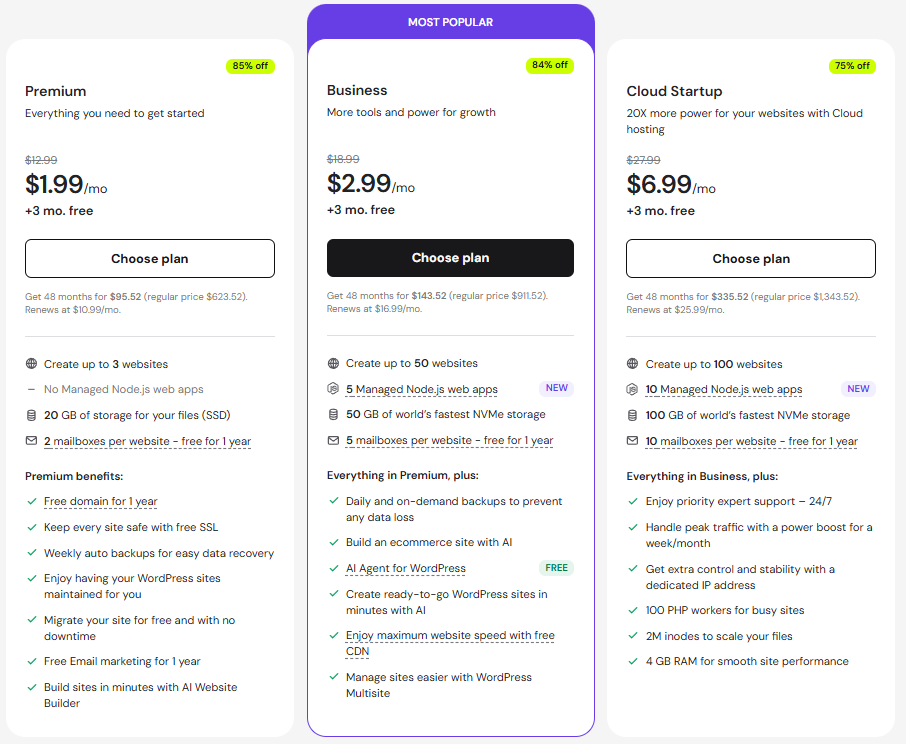
In this Hostinger vs HostGator pricing comparison, the biggest difference is not just the intro rate but the long-term renewal cost.
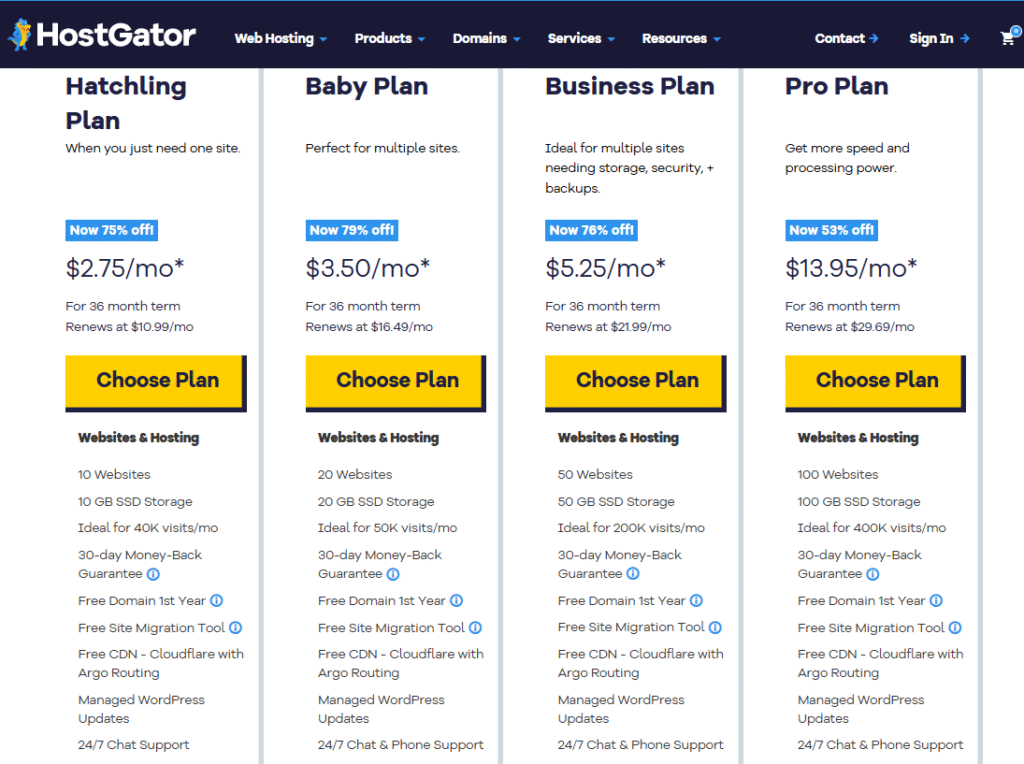
At first glance, both brands look affordable. But the homepage price alone does not tell you which host is the smarter buy. You need to compare the promotional rate, the billing term needed to unlock it, what happens at renewal, and whether anything extra gets added after checkout.
Hostinger’s official pricing page clearly separates discounted pricing from renewal pricing.
HostGator also promotes budget-friendly entry pricing on shared hosting, but the real picture can change once you factor in extras and long-term costs.
What buyers should actually compare
Do not compare only the cheapest monthly number.
Compare the first-term total, the renewal cost, whether a free domain comes with strings attached, whether email is bundled cleanly, and whether you will need to pay extra for migration, security, or backups later.
That is the difference between “cheap hosting” and “good value.”
Hostinger vs HostGator Pricing and Renewal Comparison
Renewal pricing is one of the biggest reasons buyers regret budget hosting.
Hostinger openly shows that its lower intro price is promotional and that renewal pricing is higher. That transparency helps, but it also means you should judge Hostinger on the second bill, not just the first one.
HostGator’s issue is not only renewal pricing. It is also the way extra charges can quietly change the long-term cost. On current HostGator pages, the Professional Email free trial auto-renews unless cancelled, and HostGator’s help content notes a non-refundable domain fee in qualifying refund cases.
Renewal verdict
Hostinger is easier to trust on value if you are paying attention to the renewal math.
HostGator can still work, but it requires more careful reading of the fine print.
Ease of Use Comparison
When comparing Hostinger vs HostGator, beginners usually find Hostinger easier, while cPanel users may prefer HostGator. This comes down to hPanel vs cPanel.
Hostinger uses hPanel, its custom dashboard. HostGator uses cPanel on shared hosting. That is one of the most practical differences in this comparison.
Hostinger ease of use
Hostinger feels easier for complete beginners. The setup flow is more guided, the interface feels more modern, and it is less intimidating for people launching a first blog, small business site, or affiliate site. Current comparison pages regularly favor Hostinger on ease of use for that reason.
HostGator ease of use
HostGator is easier for buyers who already know cPanel or prefer using standard hosting tutorials and workflows. If you have used cPanel before, HostGator may feel more familiar from day one.
Ease of use verdict
For total beginners, Hostinger wins.
For cPanel users, HostGator is still the more natural fit.
Performance Comparison
Budget hosting buyers care about speed more than ever, especially for WordPress, affiliate content sites, and small business pages.
Current third-party comparisons often place Hostinger ahead of HostGator on overall performance and value. Cybernews and Website Planet both frame Hostinger as the stronger option on speed-related buying value, while HostGator tends to stay competitive more on support familiarity than raw value perception.
That does not mean HostGator is unusable. It means Hostinger has the stronger performance story for most entry-level buyers.
Performance verdict
For a beginner WordPress site, blog, or small business website, Hostinger has the stronger overall performance-value positioning.
Hostinger vs HostGator: Which Is Better for WordPress?
For WordPress users, Hostinger vs HostGator comes down to ease of setup, dashboard preference, and overall value.
Both hosts support WordPress.
The real question is which one makes WordPress easier to launch and manage.
HostGator offers one-click WordPress installs and traditional shared-hosting compatibility. Hostinger also supports easy WordPress setup and is more often recommended by current comparison pages for beginners who want a simpler path to getting a site live.
WordPress verdict
Choose Hostinger if you want a smoother first WordPress experience.
Choose HostGator if you already know cPanel and want a more standard hosting setup.
Support Comparison
Support can matter just as much as speed for first-time buyers.
HostGator’s pages strongly emphasize 24/7/365 support, and third-party comparisons often give it a slight edge for traditional support availability. Hostinger also offers 24/7 support, but its bigger advantage is reducing the amount of support a beginner may need in the first place through easier onboarding.
Support verdict
If you want the stronger traditional support story, HostGator has the edge.
If you want a setup that feels simpler and more beginner-friendly from the start, Hostinger still comes out ahead overall.
Security and Backups Comparison
Security and backups matter more than many buyers realize, especially once a site starts getting traffic.
Hostinger promotes free SSL, regular backups on qualifying plans, malware scanning on some tiers, and a 99.9% uptime guarantee. HostGator promotes free SSL and 99.9% uptime, while also offering products like SiteLock and CodeGuard within its ecosystem.
Security and backups verdict
Hostinger feels stronger on included-value perception.
HostGator is workable, but buyers should pay closer attention to which protections are included and which ones may become add-ons.
Domain and Email Comparison
This section matters because it affects the real ownership cost.
Both brands offer a free domain on qualifying plans. But domain offers are not always as simple as they look. Hostinger’s refund policy notes that if a free domain was included, the domain cost may be deducted from the refund. HostGator’s help content notes a non-refundable domain fee in qualifying cases, and its shared hosting flow also includes a Professional Email trial that auto-renews unless cancelled.
Domain and email verdict
Hostinger feels cleaner and easier to recommend here.
HostGator requires more attention to the details.
Pros and Cons of Hostinger
Pros
Hostinger stands out for value, ease of use, free migration, beginner fit, and a strong WordPress-first experience. It is also the host more current comparison pages tend to recommend overall.
Cons
The biggest downsides are that it does not use cPanel and that the intro pricing can make the long-term cost feel lower than it really is if you do not check renewal rates.
Pros and Cons of HostGator
Pros
HostGator still has a real place in the market for users who want cPanel, familiar hosting workflows, and a traditional support-led experience.
Cons
Its value story is weaker, its extra-cost caveats are easier to miss, and it is less compelling for true beginners than Hostinger.
Who Should Choose Hostinger
Choose Hostinger if you are starting your first website, launching a blog, building an affiliate site, setting up a small business website, or moving from another host and want an easier migration process.
It is the better fit when simplicity, value, and beginner-friendliness matter more than having cPanel.
Who Should Choose HostGator
Choose HostGator if you already know cPanel, prefer traditional hosting dashboards, or feel more comfortable using standard hosting tutorials and legacy workflows.
That is the clearest reason to pick HostGator over Hostinger today.
Who Should Avoid Hostinger
Avoid Hostinger if your main requirement is cPanel.
Also skip it if you strongly prefer a traditional hosting layout and do not want to learn a custom panel, even one designed for beginners.
Who Should Avoid HostGator
Avoid HostGator if you want the cleanest beginner setup, the strongest value impression, or fewer hidden-cost concerns around domains and email.
It is also not the best choice for buyers who want the least complicated budget-hosting experience.
Best Alternative if Neither Is Right
If neither Hostinger nor HostGator feels right, the best move is often to step up to a more premium host.
That is especially true if your site is already tied to revenue, your traffic is growing fast, or you care more about long-term support quality and fewer tradeoffs than saving money on the first bill.
In other words, if you already know budget shared hosting is a compromise, it may be smarter to skip both and buy for stability instead of headline price.
FAQ
Is Hostinger better than HostGator?
For most beginners, yes. Hostinger is easier to recommend for value, ease of use, migration, and beginner-friendly WordPress hosting, while HostGator is more appealing mainly for cPanel users and buyers who prefer a traditional hosting setup.
Is HostGator better for cPanel users?
Yes. If cPanel is a must-have for you, HostGator is the better fit because it still centers its shared hosting around cPanel.
Is Hostinger vs HostGator better for beginners?
Hostinger is the better choice for most WordPress beginners because its onboarding is simpler and its overall user experience is easier to navigate.
Does HostGator have hidden costs?
It can. The biggest ones to watch are the Professional Email trial auto-renew and the domain fee caveat in certain refund situations.
Does Hostinger have renewal pricing concerns?
Yes. Hostinger’s low intro pricing is promotional, and renewal rates are higher, so it is important to compare the long-term cost before buying.
Which host is easier to migrate to?
Hostinger has the stronger migration story because it advertises free unlimited website migration.
Final Verdict
In the Hostinger vs HostGator debate, Hostinger is the better choice for most beginners, while HostGator fits users who specifically want cPanel. For most readers comparing Hostinger vs HostGator, Hostinger is the better overall buy.
It gives beginners a smoother start, a stronger value impression, better migration convenience, and a more convincing beginner-to-WordPress story. HostGator still has a place, but mainly for buyers who know they want cPanel and are comfortable watching the fine print around extras and long-term costs.
The simplest way to think about it is this:
Choose Hostinger if you want the better all-around host for a first website.
Choose HostGator if you want cPanel and a more traditional hosting workflow.
Avoid both if your site is too important to trust to a budget-hosting compromise.
If you are still comparing Hostinger with other beginner-friendly hosting providers, read our detailed Hostinger vs GoDaddy for a deeper look at pricing, ease of use, and long-term value.
Affiliate Disclosure
This article may contain affiliate links. If you sign up through them, BestSaaSSpot may earn a commission at no extra cost to you. That does not affect our editorial judgment. We recommend hosts based on buyer fit, tradeoffs, and long-term value, not just headline discounts.