

Compare Hostinger and GoDaddy in 2026. Learn pricing, speed, support, and WordPress performance to choose the right hosting.
If you’re trying to decide between Hostinger vs GoDaddy, this guide covers all the essentials. Choosing the right web hosting provider is one of the most important decisions you’ll make when launching your website. With so many options available, it’s easy to feel overwhelmed. That’s why in this comparison of Hostinger vs GoDaddy, we’ll break down everything you need to know about hostinger vs godaddy—so you can make the best decision for your website.
Hostinger is known for its budget-friendly plans, high-speed performance, and modern user interface. GoDaddy, on the other hand, is one of the oldest and most recognizable names in the domain and hosting industry, offering a wide range of services under one roof.
Whether you’re a beginner, blogger, small business owner, or experienced developer, this detailed comparison of Hostinger vs GoDaddy will help you understand which host offers the best value, performance, and features for your needs.
Table of Contents
1. Hostinger vs GoDaddy: Pricing and Plans Compared
When comparing Hostinger vs GoDaddy, pricing is often the first thing users look at—and for good reason. Both companies offer a range of plans tailored to different types of users, from beginners to growing businesses.
Hostinger Pricing Overview
Hostinger is well-known for its affordable entry-level pricing, making it a popular choice for beginners and budget-conscious users.
Understanding the details of hostinger vs godaddy is crucial for making an informed choice.
- Shared Hosting starts at $1.99/month (Single Plan)
- Premium Shared Hosting at $2.99/month with more features
- WordPress Hosting starts at $2.99/month
- VPS Hosting from $5.99/month
- Cloud Hosting starts at $9.99/month
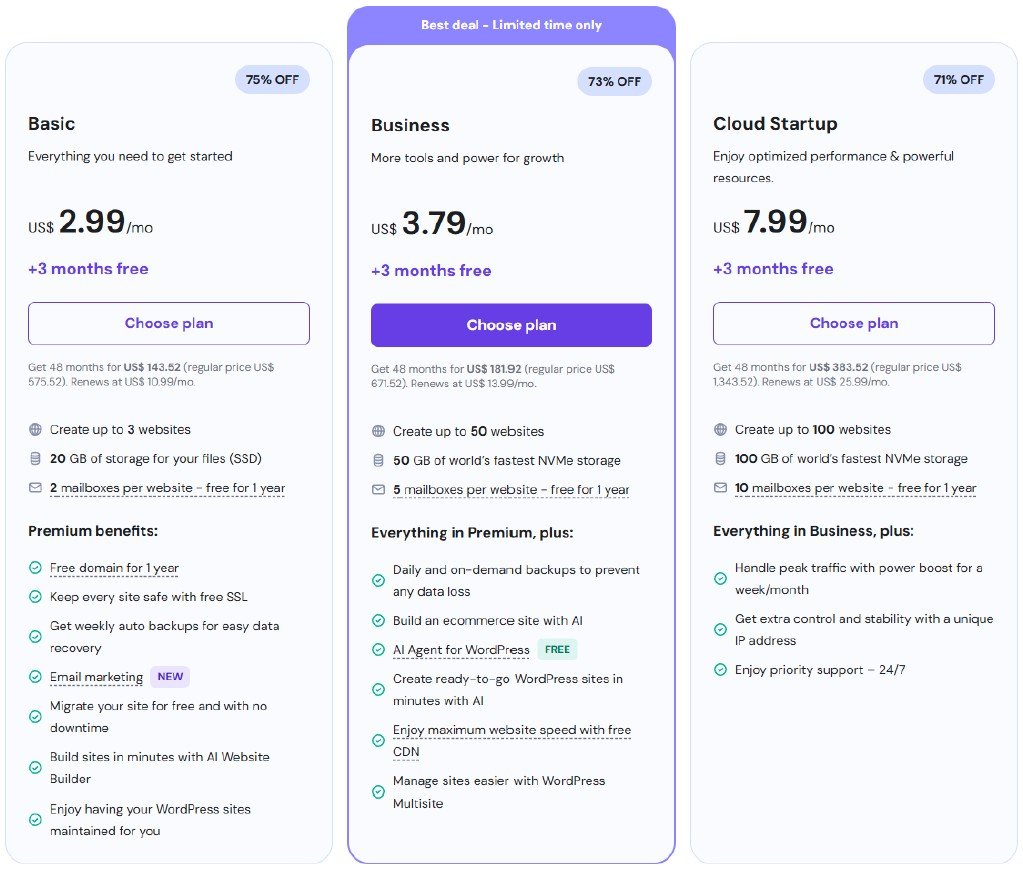
Hostinger frequently offers long-term discounts when you sign up for 12, 24, or 48 months. Renewal rates are higher, but still competitive.
GoDaddy Pricing Overview
GoDaddy tends to be slightly more expensive, especially after the promotional period ends.
- Shared Hosting starts at $5.99/month (Economy Plan)
- WordPress Hosting from $8.99/month
- VPS Hosting begins at $9.99/month
- Dedicated Servers start around $129.99/month

GoDaddy offers monthly billing options, which is great for short-term projects, but long-term plans can get costly due to higher renewal prices.
Key Differences
- Hostinger is cheaper for almost all plans, especially WordPress and shared hosting.
- GoDaddy provides monthly billing, while Hostinger pushes longer commitments.
- Hostinger includes more features (like SSL and backups) in its base plans, reducing the need for paid add-ons.
2. Features
When deciding between two hosting giants like Hostinger and GoDaddy, it all comes down to features. Sure, pricing matters—but features are what actually power your website and impact things like speed, security, and scalability.
| Feature | Hostinger | GoDaddy |
|---|---|---|
| 1. Free Domain | ✅ 1 year on most plans | ✅ 1 year on most plans |
| 2. Free SSL | ✅ Lifetime | ✅ 1st year only |
| 3. Storage Type | ✅ NVMe SSD | ✅ Standard SSD |
| 4. Backup Frequency | ✅ Weekly (Free), Daily (Premium) | ❌ Paid Add-on |
| 5. Free Email | ✅ Yes (on all plans) | ❌ Paid Add-on |
| 6. Website Builder | ✅ Zyro Builder (AI-powered) | ✅ Basic Builder |
| 7. Control Panel | ✅ Custom hPanel | ✅ cPanel |
| 8. CDN Integration | ✅ Free Cloudflare CDN | ✅ Cloudflare CDN |
| 9. Server Cache | ✅ LiteSpeed Caching | ❌ Not included |
| 10. Website Staging | ✅ Yes (WordPress plans) | ❌ Only on higher-tier plans |
| 11. Malware Protection | ✅ Free Malware Scanner | ❌ Paid Security Add-on |
| 12. Performance Optimization | ✅ Built-in | ❌ Limited (unless upgraded) |
| 13. Uptime Guarantee | ✅ 99.9% SLA | ✅ 99.9% SLA |
| 14. SSH Access | ✅ Included | ✅ Included |
| 15. Git Integration | ✅ Available | ❌ Not offered |
| 16. Cron Jobs | ✅ Yes (even in basic plans) | ✅ Yes |
| 17. WordPress Optimization | ✅ LiteSpeed, WP Accelerator | ❌ Basic WP Install Only |
| 18. Free Website Migration | ✅ Yes | ❌ Paid migration |
| 19. Customer Support | ✅ 24/7 Live Chat | ✅ 24/7 Phone & Chat |
| 20. Money-Back Guarantee | ✅ 30 Days | ✅ 30 Days |
3. Performance and Speed
When comparing Hostinger vs GoDaddy and evaluating hostinger vs godaddy, performance and speed are critical factors—especially if you want faster load times, better SEO rankings, and happier visitors. Here’s how both hosting providers stack up in real-world speed tests and performance benchmarks.
Speed Technologies and Infrastructure
Hostinger:
- Uses LiteSpeed Web Server—a high-performance alternative to Apache that comes with built-in caching (LSCache plugin for WordPress).
- Equipped with SSD storage on all plans for faster file access.
- Offers global data centers in the US, UK, Singapore, India, and Europe to reduce latency.
GoDaddy:
- Uses standard Apache/Nginx servers for most plans.
- Provides HDD or SSD depending on the plan (SSD more common in higher tiers).
- Fewer global data centers and no LiteSpeed support.
Image Suggestion: Use a visual map showing data center locations for Hostinger and GoDaddy for a quick performance overview by region.
Real-World Speed Results
Here’s how they performed in third-party tests (average for shared hosting):
| Metric | Hostinger | GoDaddy |
|---|---|---|
| Load Time (Global) | ~350ms – 600ms | ~500ms – 800ms |
| Time to First Byte | 0.18s – 0.25s | 0.30s – 0.45s |
| GTmetrix Grade | A | B |
| Server Uptime | 99.99% (tracked) | 99.95% (tracked) |
Hostinger consistently outperforms GoDaddy in load times and server response, especially for WordPress websites, thanks to its LiteSpeed tech.
Image Suggestion: Add a performance comparison bar chart or GTmetrix screenshot of load speed results to visually represent the data.
Why Speed Matters
- Improved SEO: Google uses site speed as a ranking factor.
- Higher Conversions: A delay of even 1 second can reduce conversions by 7% (source: Akamai).
- Better User Experience: Visitors are likely to leave a slow site within 3 seconds.
If you’re building a blog, eCommerce store, or portfolio, choosing the faster host can directly impact your growth.
4. Hostinger vs GoDaddy Uptime and Reliability
When evaluating Hostinger vs GoDaddy, pricing plays a major role. When it comes to web hosting, uptime is everything. If your site goes down frequently, you lose traffic, credibility, and potential revenue. That’s why evaluating uptime guarantee and reliability is crucial in the Hostinger vs GoDaddy comparison.
Hostinger and GoDaddy both offer a 99.9% uptime guarantee, standard for the industry. Hostinger consistently delivers real-world uptime between 99.95% to 100%, thanks to global data centers, SSD storage, and LiteSpeed web servers. It also uses proactive monitoring, custom infrastructure, and provides daily and weekly backups with most plans. Hostinger is known for reliable servers even on lower-tier plans.
GoDaddy, with data centers in North America and Europe, shows real-world uptime between 99.90% and 99.98%. It includes redundant systems and failover protection, but backups and security monitoring are available only with higher-tier plans or add-ons. While GoDaddy performs reliably, its uptime can vary slightly based on server load and location.
Verdict: Hostinger offers more consistency and modern infrastructure, particularly in shared hosting, while GoDaddy performs well but may not match Hostinger’s uptime.
5. Security Features
Hostinger and GoDaddy offer security features essential for website protection. Hostinger includes a free SSL certificate, daily or weekly backups, malware scanning, DDoS protection, Cloudflare CDN, firewalls, and two-factor authentication (2FA) on most plans, providing strong security without extra costs. It uses tools like BitNinja or Imunify360 for proactive protection.
GoDaddy provides basic security tools, but many are paid add-ons. Free SSL is available only on higher-tier plans, and daily malware scanning and backups are part of extra-cost Website Security plans. While GoDaddy offers 24/7 monitoring, firewalls, and optional DDoS protection, these come with additional charges.
Verdict: Hostinger includes more security features by default, even on basic plans, while GoDaddy requires purchasing add-ons for comprehensive protection, making it less budget-friendly.
6. WordPress Integration and Optimization
Hostinger offers seamless WordPress integration with one-click installation, pre-installed LiteSpeed Cache, automatic updates, and staging tools on higher plans. Its LiteSpeed servers enhance performance, making it ideal for dynamic websites. Hostinger also provides developer-friendly tools like WP-CLI and SSH access.
GoDaddy also supports WordPress with one-click installation, automatic updates, and a performance dashboard, but it relies on standard Apache servers, which may not match LiteSpeed’s performance. Advanced optimization tools come at an extra cost, and staging is only available on higher plans.
Verdict: Hostinger offers superior performance and optimization out of the box, while GoDaddy’s features are more basic and require additional costs for better performance.
7. Customer Support and Service Quality
Hostinger provides responsive 24/7 live chat support with multilingual options, a comprehensive knowledge base, and a ticketing system. It lacks phone support but offers fast and helpful service, resolving most issues without escalation.
GoDaddy offers more support channels, including 24/7 phone and live chat, with international numbers. It also has a knowledge base, video guides, and forums. However, some users report slower response times and inconsistent support quality.
Verdict: Hostinger excels in fast, professional live chat support, while GoDaddy offers more contact options but may not be as responsive. If quick replies are a priority, Hostinger is the better choice.
8. Ease of Use and Control Panel
Hostinger uses a custom control panel, hPanel, designed for simplicity and speed. It features an intuitive, clean dashboard with easy access to essential tools like file manager, WordPress, domains, and email. hPanel is beginner-friendly with one-click installations and built-in performance/security tools.
GoDaddy uses the traditional cPanel, offering a familiar but complex interface. It includes extensive features, but can overwhelm beginners. GoDaddy also has a separate dashboard for account and billing management and a simplified setup for WordPress.
Verdict: Hostinger’s hPanel is more user-friendly and modern, ideal for beginners, while GoDaddy’s cPanel offers more features but requires a learning curve.
9. Website Builder and Tools
For users who want to build a website without coding, a good website builder can make all the difference. In this Hostinger vs GoDaddy comparison, we’ll explore the built-in tools and builders both hosts offer to help you create and manage your site.
Hostinger Website Builder and Tools
Hostinger offers its own drag-and-drop builder called Hostinger Website Builder (formerly Zyro). It’s designed for simplicity and speed.
- Easy-to-use drag-and-drop interface suitable for beginners
- Built-in AI tools like AI Writer, AI Heatmap, and logo maker
- Mobile-responsive templates with modern design
- Fast loading and optimized for performance
- E-commerce features available on business plans
- Separate from WordPress but great for simple websites
In addition to the builder, Hostinger provides tools like Git integration, WP-CLI, SSH access, and a custom domain manager for more advanced users.
GoDaddy Website Builder and Tools
GoDaddy offers its own GoDaddy Website Builder, also built with beginners in mind.
- User-friendly interface with step-by-step guidance
- Pre-designed themes tailored to industries like retail, restaurants, and services
- Built-in marketing tools such as email marketing and SEO wizards
- E-commerce functionality available on premium plans
- Mobile editing capabilities through the GoDaddy mobile app
GoDaddy also includes domain management, basic email tools, and one-click install apps for CMS platforms like WordPress, Joomla, and Drupal.
10. Freebies and Inclusions
When choosing a hosting provider, it’s important to look beyond the price tag and consider the extras included in the plan. These add-ons can save money and simplify your setup process. In this Hostinger vs GoDaddy comparison, we’ll break down what freebies you can expect from each provider.
Hostinger Freebies
Hostinger is known for offering a generous set of free features, even on its lower-tier plans. These inclusions are particularly helpful for beginners and small businesses looking to get started without additional costs.
- Free SSL certificate on all hosting plans
- Free domain name with Premium and Business plans (for the first year)
- Free email accounts (based on plan)
- Free weekly or daily backups depending on plan level
- Free website migration for WordPress users
- Cloudflare CDN integration included
- Access to Hostinger AI tools with the Website Builder
These features are built into the hosting cost, making Hostinger a strong value pick for users who want a lot without spending extra.
GoDaddy Freebies
GoDaddy includes some useful features, but many tools are either limited to higher-tier plans or come as paid add-ons.
- Free SSL only on mid-tier and higher plans
- Free domain included with most annual hosting plans
- Free business email for the first year (then paid)
- No free backups or migrations on basic plans
- Website builder included on all plans, but advanced features require upgrades
- Marketing tools like SEO wizard included in premium builder packages
While GoDaddy does offer some generous inclusions, it often requires upgrading plans or paying extra to access the full suite of features.
nt with fewer hidden costs, Hostinger comes out ahead.
11. Scalability and Growth Options
As your website grows, your hosting needs will evolve. Whether it’s higher traffic, more storage, or advanced features, your hosting provider should offer a clear upgrade path. In this Hostinger vs GoDaddy comparison, we’ll examine how well each host supports long-term growth and scalability.
Hostinger Scalability Options
Hostinger is designed to accommodate both beginners and growing businesses. It offers a smooth transition from shared hosting to more powerful environments without major migration headaches.
- Shared Hosting to Cloud Hosting upgrades available with one click
- VPS Hosting plans with full root access for advanced customization
- Cloud Hosting solutions with dedicated resources
- Multiple tiers within each hosting type to fit different traffic levels
- Integration with domain, email, and website builder tools for expansion
- WordPress staging environment and caching tools on higher plans
Hostinger’s infrastructure is flexible, and upgrades can be done from the dashboard, allowing users to scale resources without moving to another provider.
GoDaddy Scalability Options
GoDaddy also provides a wide range of hosting types to support growing websites, especially for small to medium-sized businesses.
- Shared, WordPress, VPS, and Dedicated Server hosting options
- Business hosting with isolated resources for high-traffic sites
- VPS and Dedicated Server plans allow full customization
- E-commerce-ready WordPress plans with WooCommerce integration
- Advanced users can configure performance settings via cPanel
- Separate billing and management dashboards for multi-site control
GoDaddy supports growth, but some users may find the transition between plans slightly less intuitive compared to Hostinger’s centralized dashboard.
Verdict
In the Hostinger vs GoDaddy scalability comparison:
- Hostinger offers a more seamless and beginner-friendly upgrade path, with fast provisioning and easy plan transitions.
- GoDaddy supports more advanced configurations, making it suitable for users with specific hosting requirements or enterprise-level needs.
For most users looking to grow from a small site to a larger platform, Hostinger provides a smoother and more cost-effective scalability path.
12. Developer Features and Advanced Tools
For developers and tech-savvy users, a hosting platform must offer more than just basic functionality. Access to advanced tools, flexibility, and control are essential for customizing websites, managing deployments, and scaling applications. In this Hostinger vs GoDaddy comparison, let’s explore the developer-friendly features each host provides.
Hostinger Developer Tools
Hostinger offers a solid range of developer tools, especially considering its budget-friendly pricing.
- Full SSH access available on most plans
- Git integration for version control
- WP-CLI support for advanced WordPress management
- Access to phpMyAdmin and MySQL databases
- Multiple PHP versions available (easily switchable)
- Cron jobs for task automation
- Custom caching with LiteSpeed integration
- API support for developers managing multiple sites
Hostinger’s lightweight custom hPanel makes it easy to manage these tools without unnecessary complexity. It is particularly well-suited for freelancers, web developers, and small agencies.
GoDaddy Developer Tools
GoDaddy also caters to developers but with a slightly different focus and structure.
- SSH and SFTP access on all Linux-based plans
- Git version control supported on VPS and dedicated servers
- Full root access on VPS and dedicated plans
- cPanel and WHM for advanced configuration
- Support for multiple programming languages including PHP, Python, Perl
- DNS management and access to advanced zone settings
- Custom scripts and apps can be installed via Softaculous
While GoDaddy offers more flexibility for complex configurations, some of the best features are locked behind VPS or dedicated hosting plans.
Verdict
In the Hostinger vs GoDaddy developer tools comparison:
- Hostinger provides essential tools even on shared plans, making it a better option for developers on a budget or working on smaller projects.
- GoDaddy is more powerful on higher-tier plans, with full control and scalability for advanced server-side development.
If you’re building custom applications or managing multiple environments, GoDaddy’s VPS and dedicated plans offer more flexibility. However, for most developers working with WordPress or light applications, Hostinger offers a more streamlined and cost-effective setup.
13. Migration and Onboarding Experience
A smooth onboarding process and hassle-free website migration are essential, especially for beginners and users switching from another host. In this Hostinger vs GoDaddy comparison, we’ll look at how each provider handles new user onboarding and site migration.
Hostinger Migration and Onboarding
Hostinger makes it easy for new users to get started, whether you’re launching a new website or moving an existing one.
- Free website migration for WordPress and other CMS platforms
- Guided setup wizard immediately after purchase
- One-click installations for WordPress and popular apps
- User-friendly dashboard (hPanel) with quick access to tools
- Step-by-step tutorials and automated setup recommendations
- AI website builder option for fast website creation
The entire onboarding experience is streamlined. Hostinger provides clear instructions, helpful documentation, and a modern interface, making it ideal for beginners or users with minimal technical experience.
GoDaddy Migration and Onboarding
GoDaddy also supports both new site creation and migrations, but the process can be more manual compared to Hostinger.
- Free WordPress site migration tool (limited to managed WordPress plans)
- Manual migration option with help from support
- Onboarding wizards for website builder and WordPress
- Multiple dashboards (billing and hosting) may feel confusing to new users
- More upsells during onboarding, which can slow down the process
- Access to expert services for paid migration or setup
While GoDaddy does offer solid tools for onboarding, the experience may not feel as cohesive or beginner-friendly, especially for users unfamiliar with traditional cPanel.
Verdict
In the Hostinger vs GoDaddy migration and onboarding comparison:
- Hostinger offers a faster, simpler onboarding experience, with free migration and automated setup tools.
- GoDaddy provides more options, but the process involves more steps and potential upsells, which could overwhelm new users.
For users looking for a quick and easy start, especially when switching hosts, Hostinger delivers a smoother overall experience.
14. Refund Policy and Money-Back Guarantee
A clear refund policy and reliable money-back guarantee give users peace of mind when trying out a new hosting provider. In this section of the Hostinger vs GoDaddy comparison, we’ll examine how both companies handle refunds and what you need to know before purchasing.
Hostinger Refund Policy
Hostinger offers a 30-day money-back guarantee on most of its hosting services, allowing users to test the platform risk-free.
- 30-day full refund for hosting, domain transfers, and most products
- Domain registrations, renewals, and privacy protection are non-refundable
- Refunds are processed quickly through the original payment method
- No cancellation fees or hidden terms for shared hosting plans
- Simple cancellation process from the control panel
Hostinger’s policy is straightforward, with clear terms and minimal restrictions for its core hosting services.
GoDaddy Refund Policy
GoDaddy also offers a 30-day money-back guarantee, but with more specific conditions depending on the billing cycle.
- 30-day refund for annual plans, but only 48 hours for monthly plans
- Domain names have separate refund timelines depending on the extension
- Add-ons like SSL, site security, and email may not be refundable
- Refunds require contacting customer support or using the online dashboard
- Processing times vary based on the payment method
While GoDaddy honors refunds for eligible products, the terms can be more complex, and some users report delays in processing.
Verdict
In the Hostinger vs GoDaddy refund policy comparison:
- Hostinger provides a simpler, more flexible refund process, especially for new users trying shared hosting.
- GoDaddy’s policy is more restrictive, particularly for monthly plans and add-on services.
If ease of refund and flexibility matter to you, Hostinger offers a more user-friendly guarantee.
15. Final Verdict: Which One Should You Choose?
After comparing features, performance, pricing, and support, the Hostinger vs GoDaddy debate comes down to what matters most to you as a website owner. Both providers have their strengths, but they serve different types of users with different priorities.
When to Choose Hostinger
Hostinger is a better fit for users who want a modern, fast, and cost-effective hosting solution. It’s ideal for beginners, bloggers, small businesses, and developers who want strong performance without overspending.
- Lower introductory prices and better value for features
- Faster speeds with LiteSpeed server technology
- Free SSL, domain, backups, and migration included in most plans
- Beginner-friendly hPanel with a clean interface
- Strong WordPress optimization and AI-powered website builder
- Simple refund policy and smooth onboarding
If you’re starting your first site or managing a few client projects, Hostinger delivers impressive performance at a low cost.
When to Choose GoDaddy
GoDaddy is a better option for users who prefer a traditional hosting provider with a wide range of services under one brand. It’s ideal for established businesses or users who want phone support and advanced hosting configurations.
- Wide selection of services including domains, marketing, and email
- 24/7 phone support in addition to chat
- Website builder with built-in marketing tools
- Scalable options for enterprise-level growth
- Familiar cPanel environment for advanced users
- More tools tailored to brick-and-mortar businesses
GoDaddy may be more suitable if you prioritize phone support, a well-known brand, and centralized service management.
Summary Table
You can help users make a quick decision by adding a feature comparison table summarizing:
| Feature | Hostinger | GoDaddy |
|---|---|---|
| Starting Price | Lower | Higher |
| Website Speed | Faster (LiteSpeed) | Average (Apache) |
| Free SSL & Domain | Included | Limited to higher plans |
| Control Panel | Custom hPanel | Standard cPanel |
| Customer Support | Live Chat Only | Phone + Live Chat |
| WordPress Optimization | Built-in + LSCWP | Basic to Advanced (paid) |
| Refund Policy | Simple 30-Day | 30-Day (Annual Only) |
FAQ: Hostinger vs GoDaddy
1. Is Hostinger better than GoDaddy for beginners?
Yes, Hostinger offers a more beginner-friendly interface, guided onboarding, and better value for essential features like SSL, backups, and site migration.
2. Which is faster: Hostinger or GoDaddy?
Hostinger generally delivers faster speeds due to LiteSpeed server technology and built-in caching, especially for WordPress websites.
3. Does Hostinger offer free migration from GoDaddy?
Yes, Hostinger provides free website migration for new users, including WordPress and other CMS platforms.
4. Can I use WordPress on both Hostinger and GoDaddy?
Absolutely. Both hosts support WordPress, but Hostinger includes more optimization tools by default, such as LiteSpeed Cache and WP-CLI.
5. Which host is better for small businesses?
Hostinger is ideal for startups and small businesses looking for low-cost, high-performance hosting. GoDaddy may suit larger businesses needing bundled services like domains, email, and marketing tools.